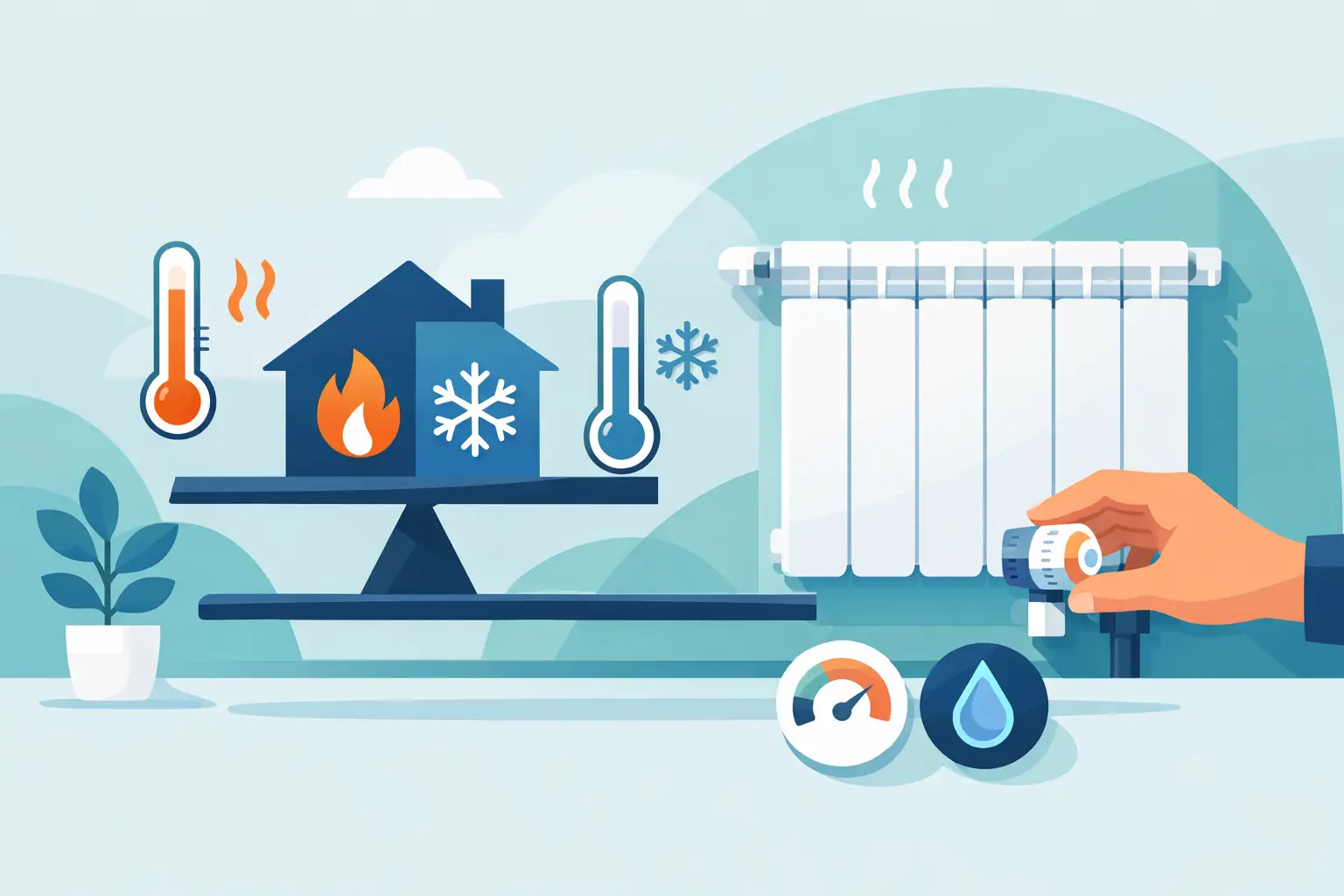
A downstairs radiator that becomes hot within minutes while the bedroom stays stubbornly lukewarm is usually not a boiler failure. It is often a circulation issue that can be corrected by learning how to balance radiators properly. Balancing controls the flow of hot water through each radiator, helping every room warm up at a more even rate.
This is different from bleeding radiators. Bleeding removes trapped air, while balancing adjusts the amount of water reaching each radiator. Both can improve comfort, but they solve different problems.
What balancing your radiators actually does
In a wet central heating system, hot water leaves the boiler and travels around a circuit of pipes and radiators. Water naturally takes the easiest route. That means radiators close to the boiler, pump or main pipework may heat quickly, while those further away receive less heat or take far longer to warm up.
Balancing restricts the faster radiators slightly at their lockshield valves, encouraging more hot water to travel around the system. The aim is not for every radiator to feel exactly the same temperature from top to bottom. It is for each room to reach a comfortable temperature without one area overheating while another remains cold.
A correctly balanced system can improve comfort and may help your heating run more efficiently. However, it cannot compensate for an undersized radiator, poor insulation, a failing pump, sludge in the system or a boiler fault. If the issue persists after balancing, a professional assessment is sensible.
Before you balance radiators properly
Start by making sure the system is generally healthy. Turn the heating off and allow all radiators to cool fully. This gives you a fair starting point and prevents you from mistaking residual heat for normal circulation.
Check each radiator for cold patches at the top. A cold top with a warmer bottom commonly indicates trapped air, so bleed that radiator before attempting to balance it. If you need to bleed several radiators, check the boiler pressure afterwards. Many sealed systems need pressure restored to the manufacturer’s recommended range before they will operate correctly.
Open every thermostatic radiator valve fully. These are normally the numbered controls at one end of the radiator. If a room thermostat is fitted, turn it up temporarily so the boiler continues calling for heat while you work. Do not cover or obstruct thermostatic valves with furniture or curtains, as this can make them respond inaccurately.
You will also need access to the lockshield valve on each radiator. It is usually at the opposite end from the thermostatic valve and often covered by a plain plastic cap. Underneath is a spindle that can be turned with an adjustable spanner, small grips or a suitable valve key, depending on the valve design.
Take a photograph or make a note of each lockshield’s initial position before moving it. This simple precaution makes it easier to return to the previous setting if needed.
How to balance radiators properly, step by step
1. Open all lockshield valves
Remove the plastic caps and turn every lockshield anti-clockwise to open it fully. Be gentle. Older valves can be stiff, and excessive force may damage the spindle or cause a leak.
With all valves open, switch the heating on and allow the system to warm up. Walk around the property and identify which radiators heat first. In many homes, these will be closest to the boiler, but pipework layouts vary, particularly after extensions or heating upgrades. Do not assume the order without checking.
2. Find the radiator that heats fastest
The radiator that becomes hot first is the starting point. Turn its lockshield clockwise until it is nearly closed, then open it again by around a quarter of a turn. This reduces its share of the water flow without shutting it off entirely.
Wait several minutes before judging the result. Heating systems do not respond instantly, especially in larger properties or homes with older pipework. Patience is essential here – repeated rapid adjustments make it difficult to know which change has helped.
3. Work through the radiators in heating order
Move to the radiator that heats next and repeat the process, generally leaving its lockshield slightly more open than the first one. Continue around the system in the order the radiators warm up.
The radiators that heat last, often those furthest along the circuit, will usually need their lockshields left more open. In some cases they may remain fully open. This gives them the best chance of receiving sufficient hot water once the earlier radiators have been restricted.
Small adjustments are best. A quarter turn can make a noticeable difference, and some systems need changes of only an eighth of a turn. There is no universal number of turns that suits every home, which is why balancing is a process rather than a fixed setting.
4. Check the temperature across each radiator
After making adjustments, allow the heating to run for at least 20 to 30 minutes. Each radiator should become hot across most of its surface, with the pipe feeding it generally warmer than the pipe returning from it.
Heating engineers often use two clamp thermometers to measure the difference between the flow and return pipes precisely. For homeowners, careful comparison by hand can provide a useful indication, but take care around hot surfaces. If a radiator is heating much faster than the others, close its lockshield slightly more. If it remains cool while the rest are hot, open its lockshield a little further.
5. Set the heating controls back to normal
Once rooms are warming evenly, return the room thermostat and thermostatic radiator valves to your preferred settings. A bedroom, hallway and living room do not necessarily need the same temperature. Thermostatic valves are designed to maintain individual room comfort after the system has been balanced.
Replace the lockshield caps when finished. These valves are not intended for everyday adjustment, so leaving the caps in place helps prevent accidental changes.
Common problems that balancing will not fix
Balancing is worthwhile when some radiators heat faster than others, but certain symptoms point to a different fault. A radiator that is cold at the top may need bleeding. One that is cold at the bottom, particularly in an older system, may contain sludge or debris that restricts water flow. This often requires professional cleaning, such as a targeted flush or power flush, rather than more valve adjustment.
A single radiator that remains cold despite fully open valves could have a stuck thermostatic valve pin, a seized lockshield, an airlock or a blockage. If the boiler pressure repeatedly drops, there may be a leak or issue with the expansion vessel. Do not keep repressurising a system without finding the cause.
If every radiator takes a long time to heat, the problem may involve boiler settings, pump performance, system design or controls. Older boilers and heating systems can also struggle when a property has been extended or rooms have been altered without reviewing radiator sizes.
When to call a heating engineer
It is reasonable to try basic balancing if the valves move freely and the system is otherwise operating normally. Stop and arrange professional help if you find a leaking valve, damaged pipework, persistent cold spots, discoloured water when bleeding, unusual boiler noises or repeated pressure loss.
A qualified heating engineer can assess circulation, check pump and boiler operation, measure radiator temperature differentials and identify whether sludge, incorrect pipework or an unsuitable radiator is affecting performance. For gas and oil heating systems, any work involving the appliance itself should always be carried out by an appropriately accredited engineer.
For homeowners across Worcestershire, Warwickshire, North Gloucestershire and The Cotswolds, Enviroplumb can investigate heating performance issues where simple adjustments are not delivering the comfort you expect. A properly balanced system should feel quietly dependable: warm rooms, sensible running times and no need to keep turning one radiator up just to compensate for another.